
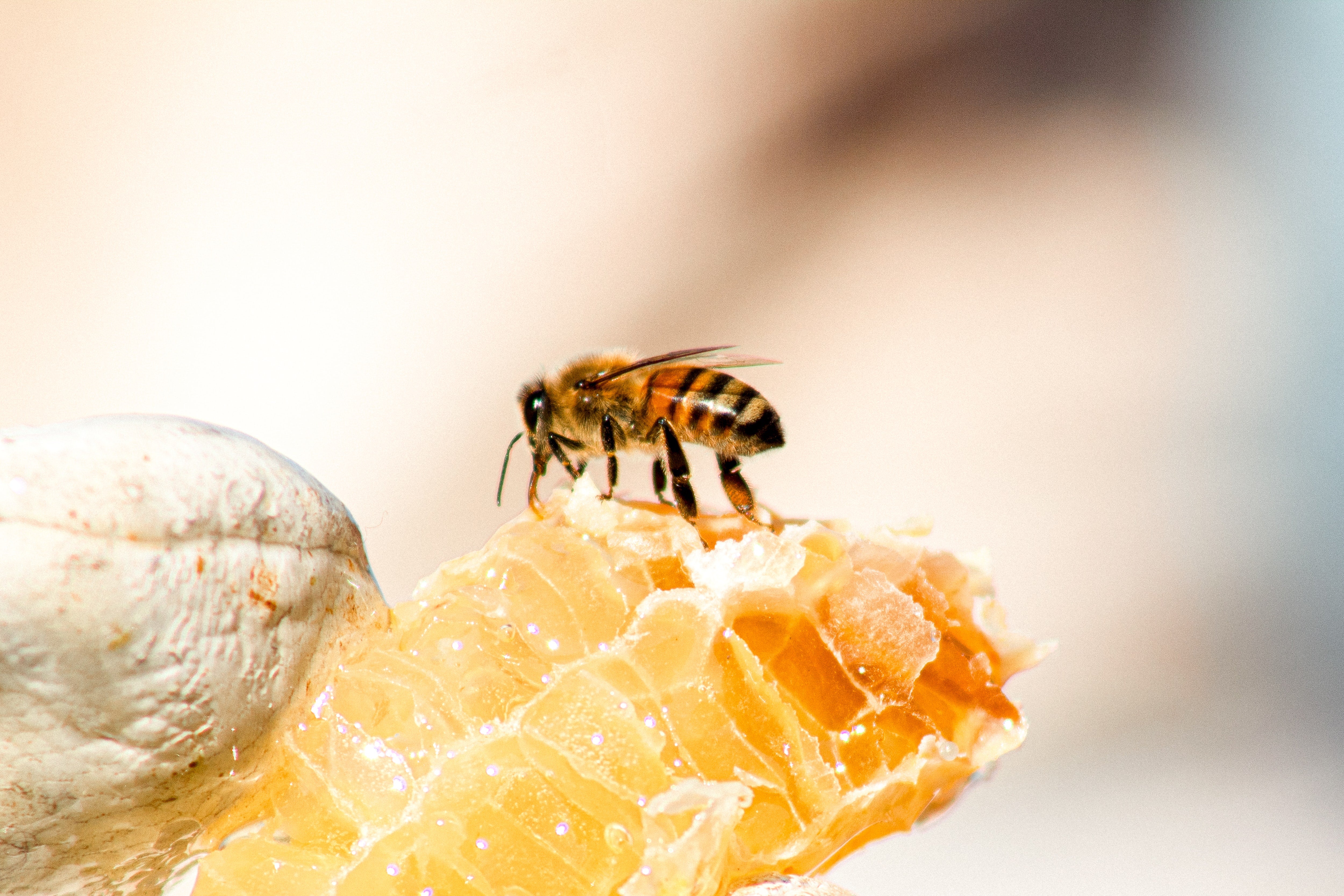
Is crystallized honey still good?
The crystallization of honey, a natural process which can be explained by several factors. Let's try to explain this phenomenon!

Photo: Honey from La Garde
First of all, what is honey made of?
Bees collect flower nectar or honeydew as raw materials. At this stage, the liquid consists of sucrose and water. These substances are then collected in the hive's combs. Bees intervene in two ways: enzymes and ventilation to produce the liquid gold: honey .
Indeed, when bees bring nectar or honeydew back to the hive, they transmit it to their fellow bees by trophallaxis (mouth-to-mouth). They then pass it several times between their mouth and their crop (bees' stomach) then give it to other bees and so on. Enzymes present in the bees' crop, invertase, diastase, and gluco-oxidase, modify sucrose into fructose and glucose. The nectar is thus transformed into honey.
Once in the honeycomb, evaporation takes place. Initially, the nectar contains 50% water. After the collective action of the bees in the hive, the honey contains approximately 17% water! Much like the evaporation of maple sap, the bees concentrate the sugars to ensure the honey's preservation.
In short, honey is mainly made up of: glucose, fructose and water (17%). It is a supersaturated sugar solution.

Photo: Honey from La Garde
Now, why does honey crystallize over time? Which honey crystallizes the fastest?
Crystallization refers to the final stage of honey development after extraction. It is a phase change (from liquid to solid). The rate at which honey crystallizes is influenced by:
- the ratio of glucose to fructose it contains;
- storage temperature;
- the amount of solid particles present in the honey, pollen for example; and
- the stirring of honey.
Some honeys crystallize faster than others. Honeys with a high glucose content will crystallize more quickly . This is the case for spring (dandelion) and autumn (aster, goldenrod, yoke weed) honeys in Quebec. In France, sunflower honey or rapeseed honey crystallize quickly.
A bee colony maintains a temperature of approximately 36°C inside the hive. At this temperature, a state of equilibrium exists between sugar and water—this is the homeostatic state. This equilibrium is disrupted when the honey is extracted, jarred, and placed in our pantry.
Conversely, high fructose honeys, such as linden honey or honeydew honey, will not crystallize as quickly. or not at all. Fructose is much more soluble in water than glucose.
The crystallization rate of honey varies from a few weeks to several months depending on the source. Temperature plays an important role in the crystallization rate and in the structure of the crystals.
Ideally, honey should be stored at around 20°C. To make our creamed honey , we lower the temperature to 14°C and stir (churn) it for a week. These are optimal conditions for obtaining fine crystals, which makes the honey creamy. By the way, if you haven't tried it yet, creamed honey is famous!

Crystallization: a reversible phenomenon
Crystallization is a reversible phenomenon. Through the action of heat, honey can become liquid again. Conveniently, you can place your jar of honey in a bain-marie or in the oven to liquefy it. A temperature of 45 °C is ideal to avoid pasteurizing the honey.
In short, the crystallization of honey is natural and does not change its properties. Honey that has become solid is still just as good. You will discover it in a different form. Let's embrace crystallization!
Article written by Miel de la Garde



Leave a comment
This site is protected by hCaptcha and the hCaptcha Privacy Policy and Terms of Service apply.